
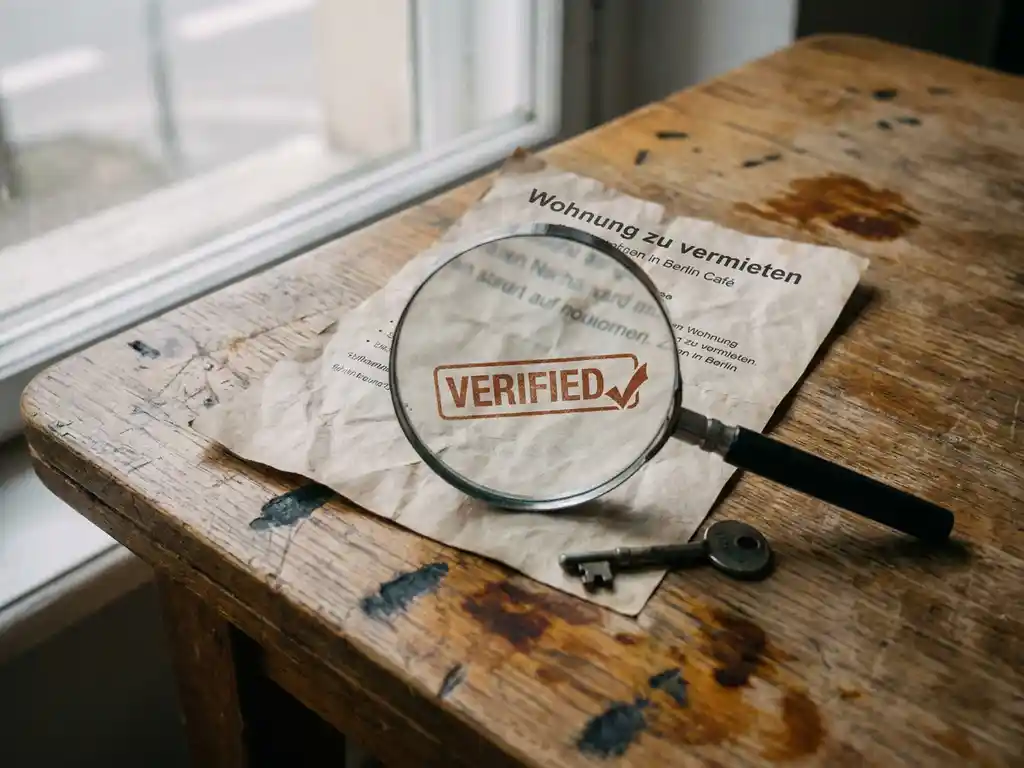
You can spot a Berlin apartment scam by watching for listings that ask for payment before a viewing, request wire transfers or gift cards, are priced well below market rate, or come from a “landlord” who claims to be abroad and cannot meet in person. These warning signs appear across all major platforms and are especially common in listings targeting international students. This article walks through each layer of the problem — from red flags to verification steps to finding housing you can actually trust.
What are the most common red flags in a Berlin rental listing?
The most common red flags in a Berlin rental listing include unusually low rent, requests for upfront payment before any viewing, landlords who refuse to meet in person, and pressure to sign or pay quickly. If a listing feels too good to be true, it almost always is — especially in a competitive city like Berlin, where affordable apartments are genuinely scarce.
Here are the specific warning signs to check before responding to any listing:
- Price significantly below market rate — A furnished one-bedroom in central Berlin typically starts well above €800/month in 2026. Listings at €400 to €500 in prime areas like Mitte or Prenzlauer Berg without a clear explanation are almost always fraudulent.
- No in-person viewing offered — Scammers frequently claim to be traveling, working abroad, or managing the property remotely. Any landlord who refuses a live or video viewing before payment is a serious risk.
- Payment requested upfront via wire transfer, PayPal, or gift cards — Legitimate landlords in Germany do not ask for a deposit or first month’s rent before you have signed a contract and received keys.
- Vague or copied listing photos — Many fraudulent listings use photos stolen from real estate portals or interior design websites. A reverse image search on Google or TinEye can expose this instantly.
- Urgency and pressure tactics — Messages that say “many others are interested” or “you must decide today” are designed to rush you into sending money before you think critically.
- Poor or inconsistent German — Scam listings are often written by non-native speakers or translated by machine. Grammatical errors and unusual phrasing in German-language listings can signal fraud.
How do scammers typically target international students in Germany?
Scammers targeting international students in Germany exploit three core vulnerabilities: distance, urgency, and unfamiliarity with local norms. Most victims are contacted before they arrive in Germany, cannot physically inspect a property, and are under pressure to secure housing before a semester starts. This makes them ideal targets for rental fraud.
The most common approach involves posting a compelling listing on a public platform, then responding quickly to inquiries with a sympathetic story — a landlord working as a missionary abroad, a professor on a research posting, or a family who has moved to another country. The fraudster builds trust through friendly email exchanges, sometimes even sending fake lease documents that look professional. The request for a deposit or first month’s rent follows, and once the money is transferred, contact stops entirely.
Students from South Asia, Africa, and other non-EU regions are disproportionately targeted because scammers know these students face additional barriers: they may not speak German, they may struggle to open a German bank account quickly, and they are often unfamiliar with what a legitimate German tenancy process looks like. The combination of geographic distance and institutional unfamiliarity creates a gap that fraudsters exploit systematically.
Which platforms and channels have the highest scam risk in Berlin?
The highest scam risk in Berlin comes from open, unverified listing platforms and social media groups where anyone can post without identity checks. Facebook groups dedicated to Berlin housing, generic classified sites like Craigslist, and informal WhatsApp networks are the most common environments for rental fraud in Germany.
Even established platforms carry risk when listings go unmoderated. On sites like WG-Gesucht and Immoscout24, fraudulent accounts do appear and can remain active for days before removal. The risk is highest in listings for short-term furnished rooms, which attract students who need housing quickly and are more willing to skip verification steps under time pressure.
Lower-risk channels include listings directly from university housing offices, verified student accommodation providers, and established property management companies with a verifiable German business address. These sources are not immune to problems, but structural accountability is higher. When you find a listing through an institutional channel, you have a real entity to contact if something goes wrong.
How can you verify whether a Berlin landlord is legitimate?
You can verify a Berlin landlord is legitimate by confirming their identity through official documents, checking that their address and contact details match verifiable business or property records, and insisting on a physical or video viewing before any money changes hands. No legitimate landlord in Germany will object to these steps.
Practical verification steps include:
- Request a copy of the Grundbuchauszug (land register extract) — This document proves the landlord actually owns the property. You can ask for a recent extract, and a genuine owner will not hesitate to provide one.
- Verify their identity document — Ask to see a German Personalausweis or Reisepass. Scammers operating from abroad cannot provide this in person.
- Conduct a video viewing of the apartment — Insist on a live video call where the landlord walks through the property in real time. Pre-recorded videos prove nothing.
- Search the address on Google Maps and Street View — Confirm the building exists and matches the listing photos.
- Check the landlord’s email domain — A legitimate property management company will use a professional domain. Gmail or Yahoo addresses from “companies” are a warning sign.
- Never pay before signing a contract — Under German tenancy law, a deposit (Kaution) is only due after a contract is signed, and it cannot legally exceed three months’ net rent.
What should a legitimate German rental contract include?
A legitimate German rental contract (Mietvertrag) must include the full names and addresses of both tenant and landlord, a precise description of the rental property, the monthly rent and utility costs (Nebenkosten), the deposit amount, and the notice period for termination. Any contract missing these elements is incomplete and potentially invalid.
Beyond the legal minimum, a trustworthy contract will also specify:
- The exact start date and, for fixed-term contracts, the end date
- What is included in the Nebenkosten (heating, water, building maintenance)
- Rules about subletting, pets, and alterations to the apartment
- The condition of the apartment at handover, ideally documented in a handover protocol (Übergabeprotokoll)
- Bank account details for rent payment — in Germany, rent is almost always paid by SEPA bank transfer, not cash
Be cautious of contracts written entirely in English with no German version available, contracts that lack a full postal address for the landlord, or agreements that ask you to waive standard tenant protections. Germany has strong tenant protection laws, and any clause that contradicts them is unenforceable — but it is still a signal that something is wrong with the arrangement.
If you are unsure about a contract’s legitimacy, the Mieterverein (Berlin Tenants’ Association) offers legal advice to members for a modest annual fee. This is one of the most cost-effective protections available to renters in Germany.
Where can international students in Berlin find safe, verified housing?
International students in Berlin can find safe, verified housing through university student services offices (Studentenwerk), accredited private student housing providers, and specialist relocation services that pre-screen landlords and listings. These channels offer significantly lower fraud risk than open listing platforms because listings are verified before students ever see them.
Reliable starting points include:
- Studentenwerk Berlin — The official student services organisation manages dormitories across Berlin. Waiting lists can be long, but the housing is affordable and legitimate.
- Your university’s international office — Many universities maintain a list of verified private landlords and housing providers they have worked with directly. This is an underused resource.
- Verified private student housing providers — Companies that specialise in student accommodation and carry out landlord and property checks before listing. Look for providers with a verifiable Berlin business registration and transparent pricing.
- Wohnheim-specific platforms — Sites like Studierendenwerk portals or DAAD housing databases list student-specific options with institutional backing.
When using any platform, prioritise listings where you can verify the provider’s identity, speak to someone directly before paying, and receive a proper German rental contract. Verified student housing services that include bureaucracy support — such as help with Anmeldung and utility setup — are particularly valuable for students arriving from outside the EU who are navigating these processes for the first time.
How PropTech 24×7 GmbH helps you avoid rental scams and find trusted housing in Berlin
PropTech 24×7 GmbH was founded specifically to solve the problem this article addresses. The founder navigated Germany’s housing market as an international student himself and built the company around the gaps he experienced firsthand. Every listing on the platform is verified before it reaches a student, and the support does not stop at handing over keys.
Here is what PropTech 24×7 GmbH provides concretely:
- Verified listings only — Every landlord and property is screened before being offered to students, eliminating the fake listing risk entirely
- 24 to 48 hour response guarantee — Students in time-sensitive situations get fast, reliable answers rather than silence from an inbox
- Scam prevention as standard — The team actively identifies and removes fraudulent listings and educates students on how to protect themselves
- Bureaucracy support included — Help with Anmeldung (address registration), utilities setup, and WiFi connection so students can focus on settling in
- Affordable entry points — Options starting at €400/month with student-friendly, flexible contracts and no hidden fees
- End-to-end support — Beyond housing, the company connects students with career opportunities, integration services, and community resources across Berlin
With 3,000+ students successfully housed across nine Berlin districts and 128+ verified partnerships with universities, landlords, and service providers, PropTech 24×7 GmbH is one of the most established specialist providers in Berlin’s student housing market. If you are looking for safe housing in Berlin without the stress of navigating scams alone, get in touch with the team today and find out what is available for your move-in date.