
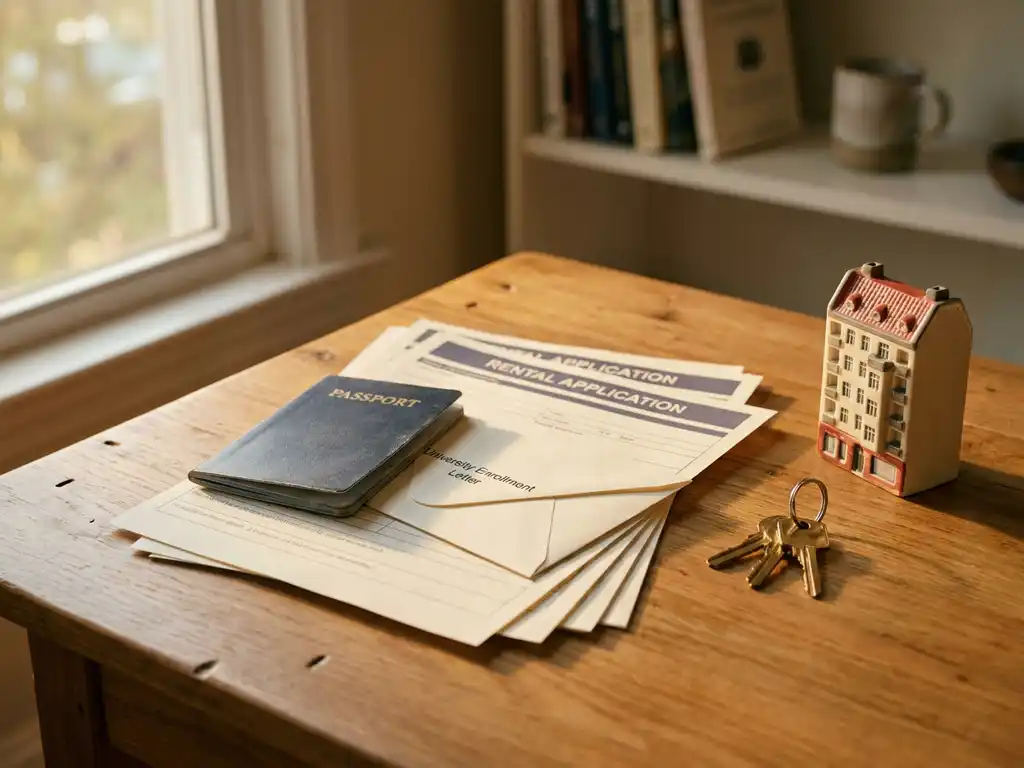
International students renting housing in Germany typically need a valid passport or national ID, proof of university enrollment, a recent bank statement or financial guarantee, and sometimes a rental application form. The exact combination varies by landlord, but most private landlords and student housing providers in Germany follow a consistent set of document expectations. The sections below break down each requirement in detail, including what to do if you lack a German credit history or local income.
Which documents do landlords in Germany most commonly request?
German landlords most commonly request a government-issued photo ID, proof of enrollment at a German university, evidence of financial means, and a completed rental application form (Selbstauskunft). Some landlords also ask for a recent CV or reference letters, especially in competitive rental markets like Berlin. Having all of these prepared in advance significantly speeds up the application process.
Here is a breakdown of the core documents nearly every landlord will expect:
- Valid passport or national ID — your primary identity document
- University enrollment certificate (Immatrikulationsbescheinigung) — confirms your student status
- Proof of financial means — bank statements, a blocked account certificate, or a parental guarantee letter
- Completed Selbstauskunft — a standard self-disclosure form covering personal and financial details
- SCHUFA credit report — requested by many landlords, though alternatives exist for international students
- Recent passport-sized photo — still requested by some more traditional landlords
For international students, the enrollment certificate and financial proof carry the most weight. Landlords use these two documents to assess whether you are a legitimate tenant who can reliably pay rent. Preparing certified translations of foreign documents, where required, is also worth doing before you start applying.
Do international students need a SCHUFA report to rent in Germany?
Many German landlords request a SCHUFA report, but international students who are new to Germany will not have one. This is a common and well-understood situation. In practice, landlords who regularly rent to students and newcomers accept alternative documents that demonstrate financial reliability in place of a SCHUFA score.
SCHUFA is Germany’s main credit reference agency. A SCHUFA report shows a person’s credit history within Germany, including loan repayments, mobile phone contracts, and other financial obligations. Because international students arriving for the first time have no German financial footprint, they simply cannot produce a SCHUFA report.
Acceptable alternatives that landlords typically accept instead include:
- A blocked account certificate (Sperrkonto) showing the required funds for your visa application
- A parental guarantee letter (Bürgschaftserklärung) signed by a parent or guardian abroad
- Recent bank statements from your home country showing consistent funds
- Proof of a scholarship or stipend from a recognized institution
If a landlord insists on a SCHUFA report and refuses all alternatives, this is often a sign they are not experienced with renting to international students. Landlords and housing platforms that specialize in student housing services are far more familiar with these situations and will work with the documentation you can actually provide.
What financial proof do students need without a German income?
Without a German income, international students can demonstrate financial reliability through a blocked account, a parental guarantee, scholarship documentation, or foreign bank statements. German landlords are primarily concerned with rent security, so any document that credibly shows you can cover monthly rent will generally be accepted.
The most widely recognized financial proof for visa and housing purposes is the blocked account (Sperrkonto). Many students open one with providers like Fintiba or Expatrio before arriving in Germany. The account holds a set amount of funds that are released in monthly installments, which directly mirrors a regular income flow and reassures landlords.
If you receive a scholarship, a formal letter from the awarding institution on official letterhead is strong financial evidence. DAAD, Erasmus, and institutional scholarships are well recognized in Germany and carry significant weight with landlords.
A parental guarantee letter is also widely used. This document should include the parents’ income details, a declaration that they will cover rent if needed, and ideally a notarized signature. Some landlords may request a certified translation into German if the letter is written in another language.
The key principle is to show that your monthly rent is covered by a reliable and documented source. Combining two of these documents, for example a blocked account alongside a scholarship letter, strengthens your application considerably in competitive housing markets.
How should documents be prepared and submitted to a German landlord?
Documents for renting housing in Germany should be organized into a single rental application dossier (Bewerbungsmappe), presented in a clean, logical order. Submitting a well-organized dossier signals reliability and professionalism to a landlord, which matters in a competitive rental market like Berlin in 2026.
A strong rental application dossier typically follows this order:
- Cover letter (brief, polite, explaining your situation and move-in date)
- Completed Selbstauskunft form
- Copy of your passport or ID
- University enrollment certificate
- Financial proof (blocked account, bank statements, or scholarship letter)
- SCHUFA report or a written explanation of why one is not available
- Reference letters if available
For digital submissions, compile everything into a single PDF file rather than sending multiple attachments. Name the file clearly, for example “RentalApplication_YourName.pdf.” Many landlords in Germany receive dozens of applications, and a disorganized submission may simply be skipped.
If any documents are not in German, consider providing a simple self-translated summary alongside the original. Certified translations are not always required at the application stage, but having them ready for the contract signing stage avoids delays. You can find guidance on navigating housing paperwork from services that specialize in supporting international students through this process.
What documents are needed after signing a rental contract in Germany?
After signing a rental contract in Germany, international students need to complete the Anmeldung (official address registration), set up utilities if not included, and arrange renters’ liability insurance (Haftpflichtversicherung). These post-contract steps are legally required or strongly advisable, and failing to complete them can create practical and legal complications.
Anmeldung: mandatory address registration
The Anmeldung must be completed within two weeks of moving into your new address. You register at your local Bürgeramt (citizens’ registration office) and receive a Meldebescheinigung, a registration certificate. This document is essential for opening a German bank account, applying for a tax ID, and accessing many other services. You will need your passport, rental contract, and a landlord confirmation form (Wohnungsgeberbestätigung) to complete the registration.
Utility setup and insurance documentation
If utilities are not included in your rent, you will need to register electricity and gas contracts in your name. This requires your passport, your new address details, and your bank account information for direct debit. Renters’ liability insurance is not legally mandatory, but many landlords strongly prefer tenants who have it, and it is widely available at low cost for students in Germany.
Keeping digital and physical copies of all signed documents, including your rental contract, Meldebescheinigung, and utility confirmations, is strongly recommended. These documents are regularly requested by banks, universities, and government offices throughout your time in Germany. Staying organized from day one saves significant time and stress later. For a full overview of what settling into Berlin involves, the PropTech 24×7 homepage outlines the support available to international students at each stage.
How PropTech 24×7 GmbH helps with housing documents for international students in Germany
Gathering and preparing the right documents for renting housing in Germany is one of the most stressful parts of relocating as an international student, especially when you are doing it from abroad without local knowledge. PropTech 24×7 GmbH was built specifically to remove that friction. The company provides end-to-end support that covers not just finding a verified apartment, but also guiding students through every document requirement before and after signing a contract.
Here is what PropTech 24×7 GmbH offers in practical terms:
- Verified listings only — every property is checked to protect students from scams and fraudulent landlords
- Document preparation guidance — support with assembling your rental dossier, including what to include when you lack a SCHUFA report
- Anmeldung and bureaucracy support — help completing your official address registration and related paperwork after you move in
- Utility and WiFi setup assistance — practical help getting essential services running in your new home
- 24 to 48 hour response guarantee — fast turnaround so you are never left waiting on critical housing decisions
- Flexible, student-friendly contracts — starting from EUR 400 per month with terms suited to student timelines
Whether you are still preparing to arrive in Germany or already searching for your first apartment in Berlin, PropTech 24×7 GmbH can guide you through the full process. Get in touch with the team to start your housing search with expert support behind you.