
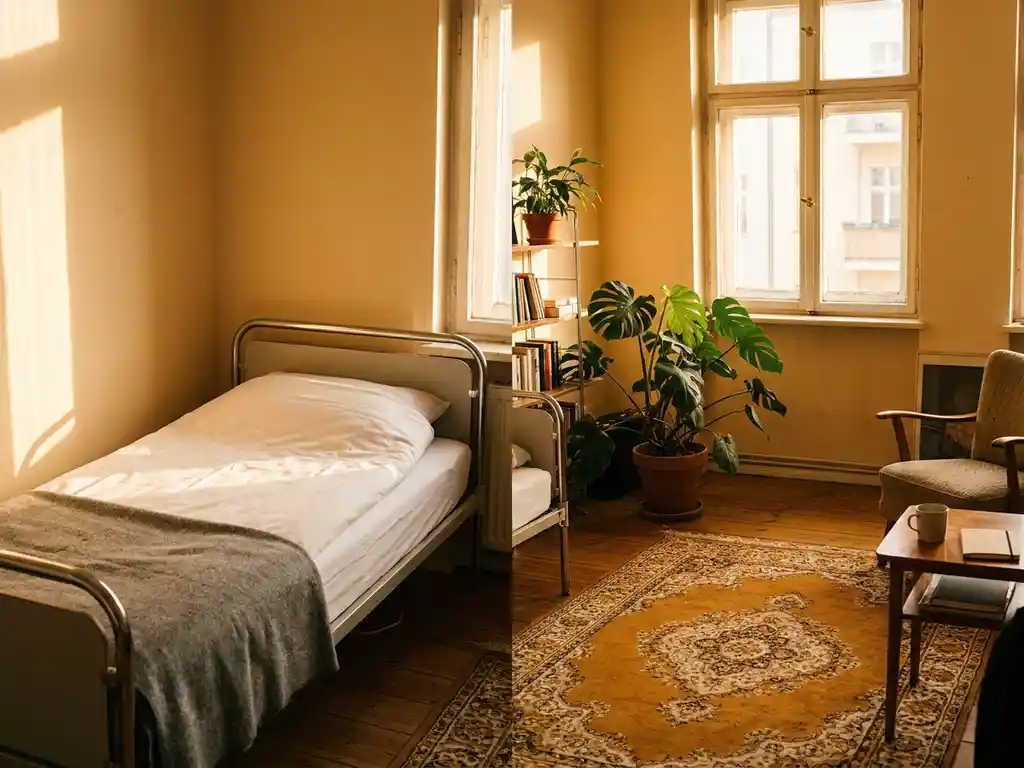
For most international students arriving in Berlin, a shared flat (WG) offers better value, more flexibility, and a richer social experience than a student dorm. That said, dorms win on simplicity and structure, making them the right call for students who want a managed, low-friction start. Your best choice depends on your budget, how quickly you need accommodation, and how comfortable you are navigating Germany’s rental market independently. The sections below break down the key differences across cost, availability, social life, and location so you can make a confident decision.
What are the real costs of a dorm versus a shared flat in Berlin?
Student dorms in Berlin typically cost between €250 and €450 per month, usually with utilities included. Shared flats (WGs) have a wider price range, generally running from €400 to €700 per month for a private room, with utilities often billed separately. On paper, dorms look cheaper, but the full picture is more nuanced than the headline figures suggest.
Dorm fees are usually all-inclusive: rent, heating, water, and sometimes internet are bundled into one predictable payment. This makes budgeting straightforward, especially in your first semester. However, dorm rooms are small, and many Studentenwohnheime operated by Studierendenwerke have long waiting lists, so the lowest-cost option is not always accessible.
WG costs vary significantly by district, flat condition, and what is included in the rent. In central areas like Mitte or Prenzlauer Berg, expect to pay toward the upper end of the range. In districts like Lichtenberg, Spandau, or Reinickendorf, rooms can be found closer to €400. On top of rent, you will typically split utility bills with flatmates, which adds roughly €50 to €100 per month depending on the season and flat size.
One often-overlooked cost factor is the deposit. WG landlords commonly ask for one to three months’ deposit upfront, which is a significant cash requirement for students arriving from abroad. Dorms managed by public bodies rarely require a large deposit. If you are managing a tight arrival budget, factor this into your comparison before deciding.
Which option is easier to find as an international student?
Finding a WG room in Berlin is generally easier and faster than securing a dorm place as an international student in 2026. Public Studentenwohnheime run by Studierendenwerke Berlin have waiting lists that can stretch from several months to over a year, and priority is often given to students already enrolled at a Berlin university.
Private WG rooms, by contrast, turn over constantly. Platforms like WG-Gesucht and Immoscout24 list hundreds of rooms at any given time. The challenge for international students is not supply but competition and credibility: landlords and current flatmates often prefer applicants who can communicate in German, show a German bank account, or provide a local guarantor.
This is where preparation makes a real difference. A well-written profile in both German and English, references from your university, and proof of enrollment significantly improve your chances. Some private student housing providers offer verified, furnished rooms with fast move-in timelines, which can bridge the gap while you search for a longer-term WG. Exploring student housing services early in your search can help you avoid the most stressful part of the process.
If your university has a dedicated international office, contact them before you arrive. Many universities maintain lists of vetted landlords or have partnerships with accommodation providers that give their students preferential access.
What’s the difference between dorm and WG social life?
The social experience in a dorm is more structured and immediately accessible, while WG life tends to be deeper and more organic over time. Neither is inherently better, but they suit different personalities and social goals.
Social life in a student dorm
Dorms place you alongside dozens or hundreds of students in a similar situation: new to Berlin, navigating the same bureaucratic hurdles, and often looking for connection. Common rooms, shared kitchens, and organized events make it easy to meet people without much effort. For students who are introverted or anxious about building a social network from scratch, this built-in community is a genuine advantage.
Social life in a shared flat
A WG offers a smaller, more intimate social unit. Living with two to four flatmates means you build fewer but often stronger relationships. Many WGs in Berlin are mixed in terms of nationality, age, and background, which can accelerate your integration into German everyday life in a way that an international student dorm bubble sometimes does not. The trade-off is that chemistry matters: a poor flatmate match can make daily life uncomfortable, and there is no residential advisor to mediate.
How does location affect the dorm vs. WG decision in Berlin?
Location plays a significant role because dorms are fixed in specific districts, while WG rooms are available across all of Berlin. If your university’s dorm is inconveniently located relative to your campus or the city centre, the cost savings may be offset by longer commute times and transport costs.
Berlin’s major universities each have their own geographic footprint. Humboldt-Universität and Freie Universität draw students toward the centre and southwest respectively, while TU Berlin sits close to Charlottenburg. Studierendenwerke dorms are clustered around these campuses, which can work well if your academic life is campus-centred. If you spend more time in the city at large, a centrally located WG might serve you better.
From a practical standpoint, Berlin’s public transport network (BVG) is extensive enough that most districts are viable for student life. A room in Neukölln or Wedding is well connected to most university campuses and significantly cheaper than a comparable room in Mitte. When comparing dorm and WG options, always map the commute to your faculty building rather than just looking at the district name.
You can get a sense of how different districts compare for student accommodation options before committing to a specific area.
Should you choose a dorm or WG if you’re new to Germany?
If you are arriving in Germany for the first time, a dorm is the lower-risk starting point, but a WG is the better long-term option for most students. The ideal approach for many international students is to secure short-term accommodation on arrival and transition to a WG once you understand the city and your own preferences.
Dorms remove several stressors at once: utilities are handled, the environment is student-oriented, and you are unlikely to encounter the housing scams that are widespread on Berlin’s private rental market. For students who have never lived independently or who are arriving without a strong German language foundation, this managed environment provides a valuable buffer.
However, dorms can also slow down your integration. When everyone around you is international and navigating the same unfamiliar systems, it is easy to stay inside that bubble rather than engaging with German bureaucracy, language, and daily life. A WG forces you to negotiate, communicate, and participate in ways that accelerate your adjustment to life in Germany.
One practical middle path: arrive with a short-term furnished room booked, register your address (Anmeldung) immediately, open a German bank account, and then begin your WG search from within Berlin. This approach gives you the stability of a dorm arrival without locking you into a long waiting list or a room that does not fit your needs. For guidance on the registration process and what to prepare, the PropTech 24×7 resource hub covers the key steps for newcomers.
How PropTech 24×7 GmbH helps with student housing in Berlin
PropTech 24×7 GmbH is a Berlin-based student housing and integration service that supports international students through every stage of finding and settling into accommodation, whether that is a dorm alternative, a private WG room, or a furnished flat for the first weeks after arrival. Founded by someone who navigated Germany’s housing market as a newcomer, the company is built around the specific challenges international students face.
- Verified listings only: Every room is checked to protect students from Berlin’s widespread housing scams
- Fast move-in timelines: A 24 to 48 hour response guarantee with rapid placement, ideal for students arriving without long-term accommodation secured
- Bureaucracy support included: Anmeldung assistance, utility setup, and WiFi activation are part of the service
- Affordable entry points: Rooms available from €400 per month with flexible, student-friendly contracts and no hidden fees
- Coverage across Berlin: Active in more than nine Berlin districts, giving students genuine choice on location
- End-to-end support: Beyond housing, the team connects students with career services, university partnerships, and community resources
If you are weighing up your options for Berlin student accommodation or need help navigating the first steps after arrival, get in touch with the PropTech 24×7 team to find a verified room that fits your timeline and budget.