
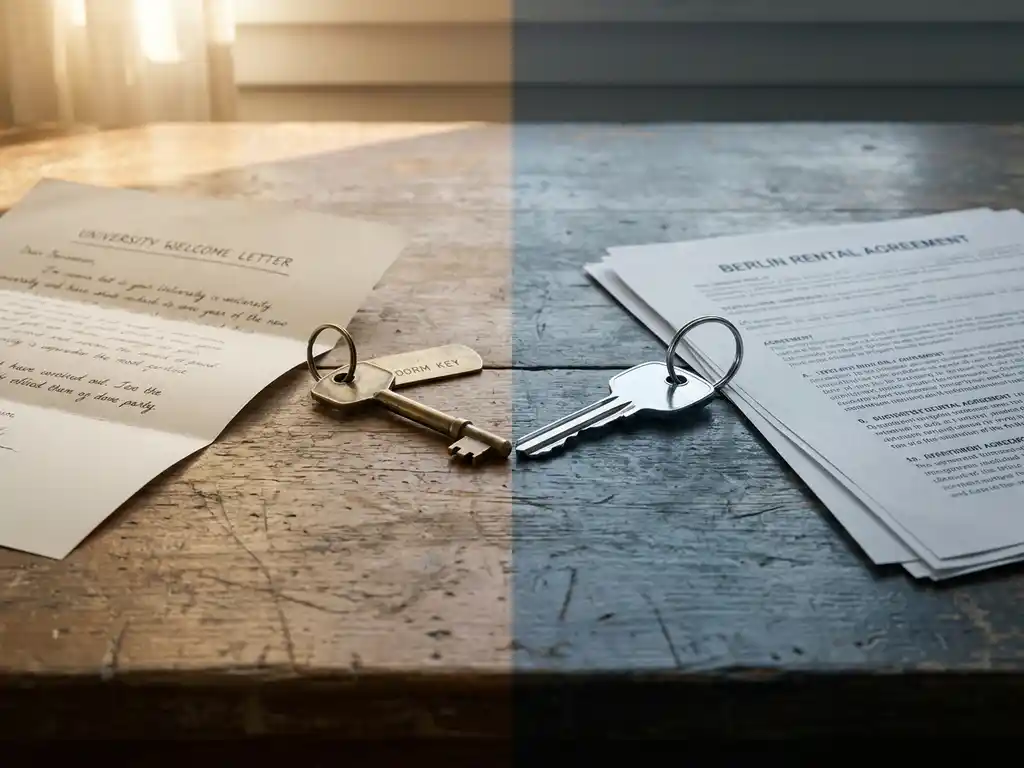
Student dormitories and private rentals in Berlin differ primarily in cost, availability, and flexibility. Dormitories offer subsidised, all-inclusive rooms managed by student organisations, while private rentals give students more independence but require navigating Germany’s competitive housing market alone. The right choice depends on your budget, timeline, and how much support you need when settling in. The questions below break down each key difference to help you decide.
Which option is cheaper: dormitories or private rentals in Berlin?
Student dormitories in Berlin are generally cheaper than private rentals. A room in a Studentenwohnheim Berlin typically costs between €250 and €450 per month, including utilities and sometimes internet. Private rooms in a shared flat (WG Berlin) start around €400 to €600 per month, while a studio or student apartment Berlin can easily exceed €800 to €1,000 per month in 2026.
The cost gap becomes even more significant when you factor in what dormitory fees include. Most Studentenwohnheim contracts bundle electricity, water, heating, and WiFi into one monthly payment. With a private rental, those costs are separate and can add €100 to €200 per month on top of your base rent. Dormitories also rarely require a large security deposit, whereas private landlords in Berlin typically ask for two to three months’ rent upfront.
That said, dormitory costs vary by provider. The Studierendenwerk Berlin, which manages the largest share of public student housing, offers some of the most affordable rates. Private dormitory operators charge more but often provide better amenities or more central locations. For students on a tight budget, affordable housing options that include utilities can be worth exploring beyond the standard channels.
How do you apply for a student dormitory in Berlin?
To apply for a student dormitory in Berlin, you must first enrol at a Berlin university and then submit an application through the Studierendenwerk Berlin or your institution’s housing office. Applications open at specific times each semester and are processed on a first-come, first-served or points-based waiting list system. Demand far exceeds supply, so applying as early as possible is essential.
The standard application process involves the following steps:
- Obtain your university enrolment confirmation or acceptance letter
- Register on the Studierendenwerk Berlin housing portal or your university’s equivalent platform
- Submit your application with the required documents, including proof of enrolment and identification
- Wait for a placement offer, which can take weeks to several months
- Accept the offer within the stated deadline and sign your contract
One important reality for international students: waiting times for public Studentenwohnheim Berlin placements can range from three months to over a year. Many students arrive in Berlin without a confirmed dormitory place and need interim housing. Private dormitory operators and student housing agencies can sometimes offer faster placements, though at a higher cost.
What are the main drawbacks of student dormitories in Berlin?
The main drawbacks of student dormitories in Berlin are long waiting times, limited availability, strict house rules, and less personal space compared to private rentals. While the low cost is attractive, the practical constraints mean dormitories are not always a reliable first-choice option for international students arriving on short notice.
Key limitations to be aware of include:
- Waiting lists: Public dormitory places are heavily oversubscribed. Securing a spot before your semester starts is not guaranteed.
- Contract rigidity: Most dormitory contracts run for a full semester or academic year with limited flexibility to leave early without penalties.
- Space constraints: Single rooms in a Studentenwohnheim are typically small, ranging from 10 to 20 square metres, with shared kitchens and bathrooms in many buildings.
- Location limitations: Not all dormitories are near your specific university or campus, which can mean long commutes.
- House rules: Dormitories enforce noise policies, guest restrictions, and common area schedules that not every student finds comfortable.
For students who value independence or need to move in quickly, these constraints can make private rentals a more practical choice despite the higher cost.
What should international students know before renting privately in Berlin?
International students renting privately in Berlin should know that the market is highly competitive, documentation requirements are strict, and housing scams targeting newcomers are widespread. Before signing any contract, students need to understand their legal rights, what documents landlords expect, and how to identify fraudulent listings.
Documents landlords typically require
German landlords almost always request a formal application package before considering a tenant. For international students, this typically includes a valid passport or ID, university enrolment confirmation, proof of income or a financial guarantee (such as a blocked account or a parental guarantee letter), and sometimes a Schufa credit report. Not having these documents ready can cost you an apartment in Berlin’s fast-moving rental market.
Scams and how to avoid them
Housing fraud is a serious issue in Berlin’s student rental market. Common scams involve listings posted at below-market prices, landlords claiming to be abroad and asking for deposits before any viewing, and fake WG Berlin listings on unverified platforms. Never transfer money or a deposit before you have physically viewed the apartment and signed a proper rental contract. Using verified listing platforms or working with a trusted student housing service significantly reduces this risk.
International students should also be aware that after signing a contract, they are legally required to register their address at the local Bürgeramt within two weeks. This process, known as Anmeldung, is essential for opening a bank account, registering with health insurance, and completing other bureaucratic steps. Many private landlords will provide a Wohnungsgeberbestätigung (landlord confirmation form) needed for Anmeldung, but it is worth confirming this before signing.
Which housing type is better for international students new to Berlin?
For international students who are completely new to Berlin, a private rental with support is generally the more reliable starting point in 2026, given the long dormitory waiting times. However, the best choice depends on how early you plan ahead, your budget, and whether you have help navigating the rental process. Students who apply for dormitories six to twelve months in advance may secure a place, making that the more affordable option.
A practical framework for deciding:
- Choose a dormitory if you apply early, prioritise low monthly costs, and are comfortable with shared facilities and house rules
- Choose a private rental if you need housing quickly, value more personal space, or want flexibility in contract length
- Consider a WG Berlin (shared flat) as a middle ground, offering lower costs than a solo student apartment Berlin while providing more independence than a dormitory
For students arriving without prior knowledge of the German rental system, the bureaucratic complexity of private renting can be overwhelming. Understanding lease terms written in German, negotiating with landlords, setting up utilities, and completing Anmeldung all require time and local knowledge that most new arrivals simply do not have on day one.
How PropTech 24×7 GmbH helps students find the right housing in Berlin
PropTech 24×7 GmbH was founded specifically to solve the challenges described throughout this article. Whether you are weighing dormitory options or navigating Berlin’s private rental market as an international student, the company provides end-to-end support so you do not have to figure it out alone.
Here is what PropTech 24×7 GmbH offers:
- Verified listings only, protecting students from the scams that are common in Berlin’s student housing market
- Affordable options starting at €400 per month with student-friendly, flexible contracts
- 24 to 48 hour response guarantee with rapid move-in timelines, ideal for students who cannot wait months for a dormitory place
- Bureaucracy support included, covering Anmeldung, utilities setup, and WiFi connection so you can focus on your studies
- 128+ partnerships with universities, landlords, and service providers across more than nine Berlin districts
If you are an international student looking for safe, affordable, and well-supported student housing in Berlin, PropTech 24×7 GmbH is ready to help you find your first home in Germany. Get in touch today and receive a response within 24 hours.